
Digital evidence
A photograph that
holds up when
someone says it was faked.
Tito Cam is a camera for iPhone and iPad that turns every capture into something an expert can verify: a digest of the file, a signature made inside the device, and a timestamp issued by an authority outside it.
Capturing, hashing, timestamping and the certificate are always free.
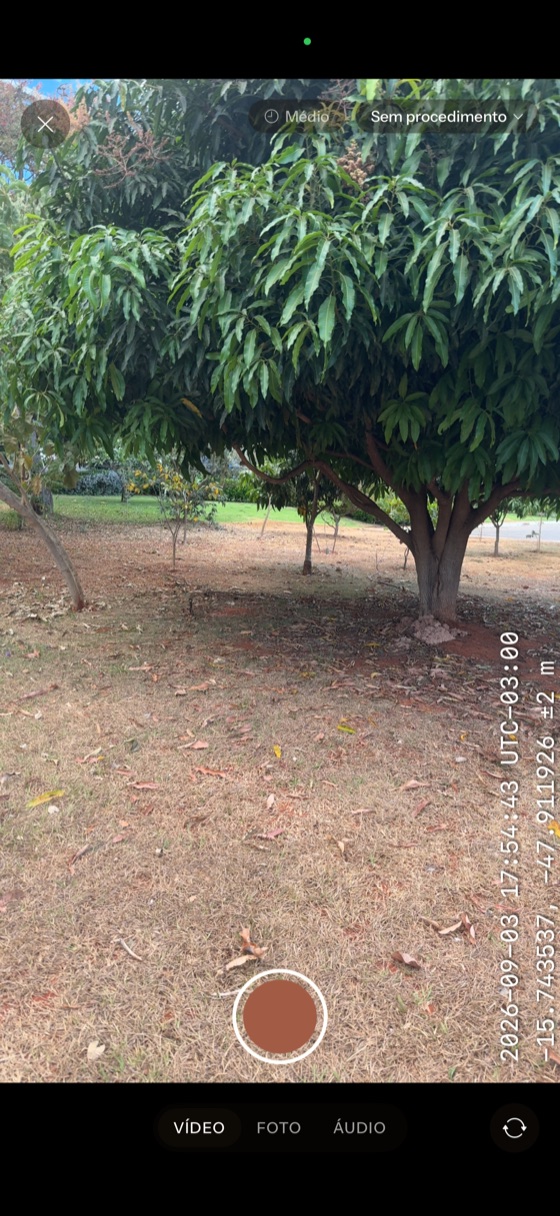
The proof is not the writing on the picture
Apps of this kind burn a date and a place onto the image. That overlay is forgeable in a minute, and it does not survive expert examination. In Tito Cam it exists only to be read at a glance. What answers the question is underneath.
A digest, at the instant it ends
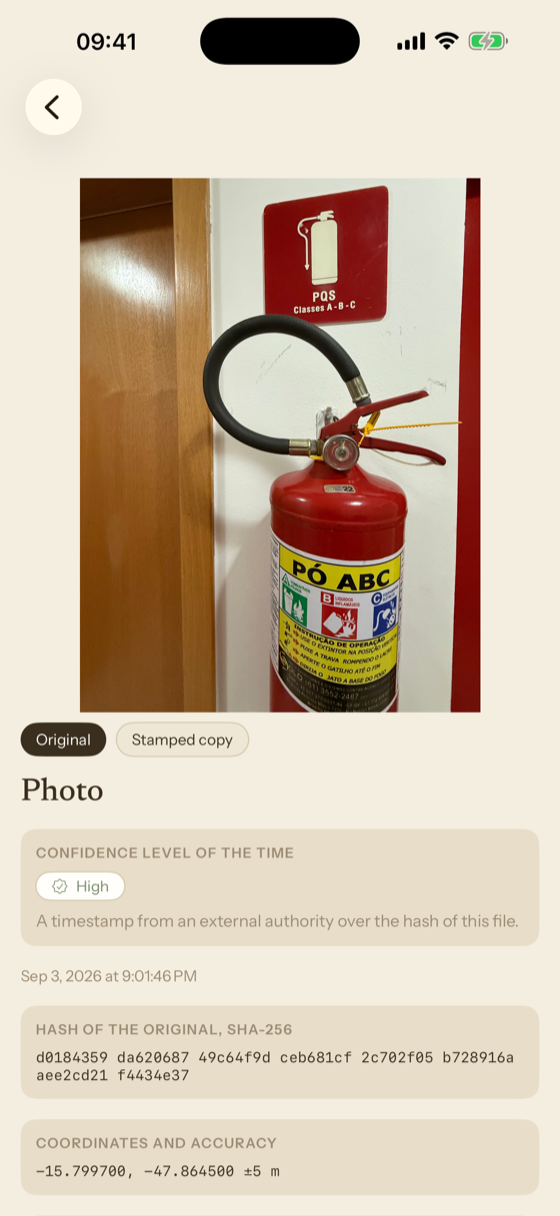
When a capture ends the app computes the SHA-256 of the file and never touches the file again. Change one byte later and the digest no longer matches.
A chain, not a pile
Each digest carries the previous record's, so removing one capture from the middle of a series becomes visible.
A signature that cannot be copied
The metadata is signed with a key generated inside the device's Secure Enclave, which cannot be extracted from it.
A timestamp from outside
The digest — and only the digest — goes to an RFC 3161 timestamp authority. The token that comes back is verifiable with OpenSSL, without this app and without trusting whoever wrote it.
A second proof of time, in Bitcoin
The same digest, with the SHA3-512 of the file, is anchored in the Bitcoin network through the calendars of OpenTimestamps. Once confirmed it depends on no authority: anyone checks it against the public ledger. Neither proof ranks above the other.
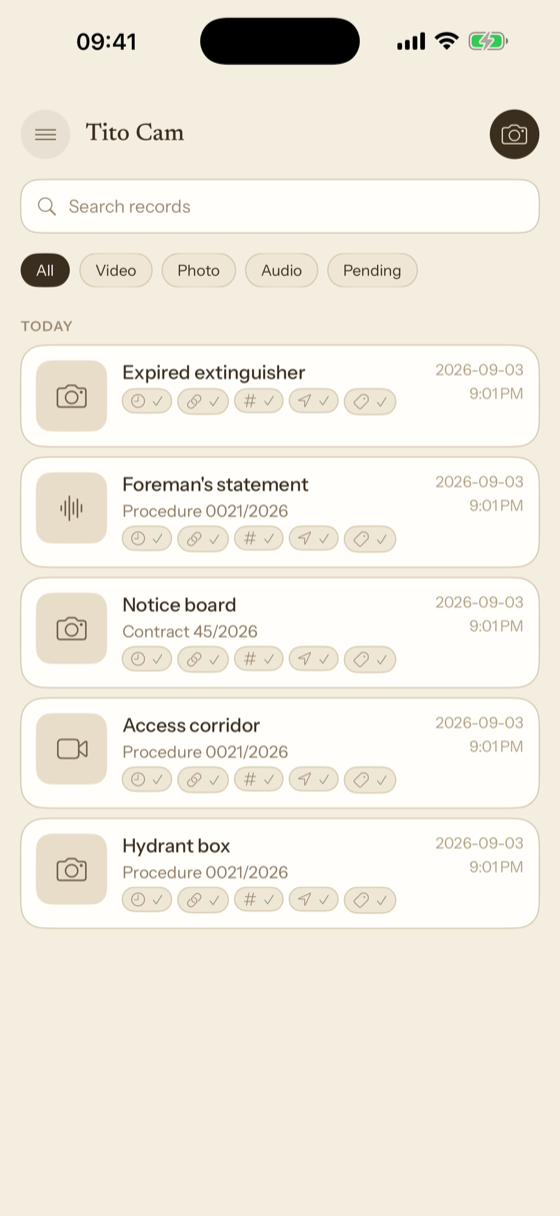
It always captures
No network, no GPS, a wrong clock, a low battery — it captures just the same. What changes is the level of confidence the record declares, never whether it can be recorded. Nothing in this app is allowed to stand between the shutter and the field.
Offline, the instant is anchored to a timestamp obtained earlier and to the device's monotonic clock, which is what makes a clock moved by hand detectable. The timestamp arrives by itself when the network returns, and the proof in Bitcoin follows within hours.
The original is never touched
No filter, no trimming, no colour correction, no re-encoding. The copy carrying the visible stamp is a separate file with a digest of its own. There is no importing from the photo library either: a record is born inside the app, in real time, or it does not exist.
A certificate anyone can check
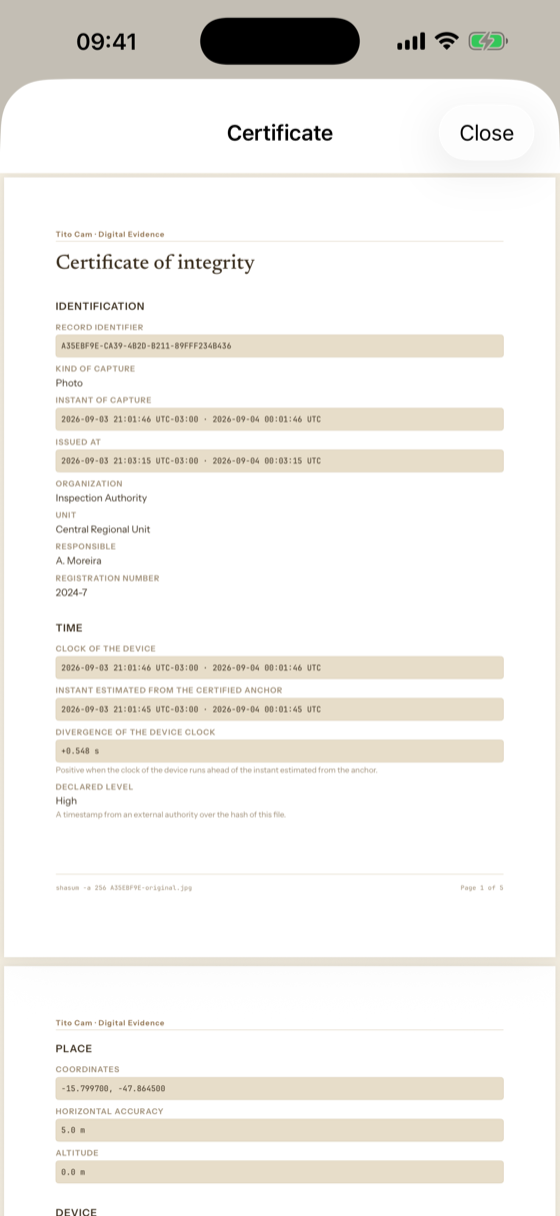
Every record produces a PDF/A-2b certificate with the metadata, the digest and its algorithm, the state of the timestamp, key frames from the video, a map of the point of capture and, in the footer, the two commands that verify it — one for the file, one for the token. Whoever receives it does not have to install anything or believe anybody.
Transcription that stays on the device
Video and statement audio is transcribed by the device itself, with timecodes, in Markdown. No audio is sent anywhere to be transcribed.
The price
Capturing, hashing, timestamping, transcribing, generating the certificate and reading all of it inside the app are free and unlimited, forever. The free tier limits one thing only: exporting out of the app, twice a month, counted per record — exporting a record you already exported costs no new quota. Tito Cam Pro, monthly or yearly with seven free days, lifts that limit. There is no advertising and no third-party SDK.
Privacy you can check
No analytics. No tracking. No advertising. No third-party SDKs. Media, transcripts and metadata stay on the device; what travels to the timestamp authority and to the calendars of OpenTimestamps is a digest, which is not data about anybody and cannot be turned back into the file. The full policy is here.